Baltic Sea: Armed Russian civilian vessel raises concerns among NATO allies
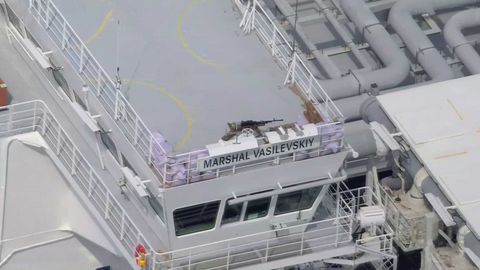
Photos published in collaboration by Helsingin Sanomat and Eesti Delfi show Russia's floating LNG terminal FSRU Marshal Vasilevsky sailing in the Baltic Sea heavily armed. This is the first photographic evidence of a Russian civilian vessel being armed in European waters. Estonian border guard photos confirm the presence of heavy machine gun armament aboard.
PoliticsAn armed Russian civilian vessel has been identified in the Baltic Sea, marking the first photographic evidence of such a development in European waters. Images released in collaboration by Helsingin Sanomat and Eesti Delfi show the floating LNG terminal FSRU Marshal Vasilevsky sailing towards Kaliningrad, with clearly visible heavy armament on board.
"The images clearly show the floating LNG terminal FSRU Marshal Vasilevsky, which transports liquefied natural gas to Kaliningrad," the publications confirmed, citing Estonian border guard photographs.
Deterrent or defence against Ukrainian strikes?
According to security experts, the vessel's arming is an ambiguous move. On one hand, it is viewed as a deterrent towards Western countries; the presence of heavy machine guns significantly changes risk analysis scenarios involving vessel seizure or boarding operations. On the other hand, it is speculated to be a defensive measure against possible Ukrainian strikes, as Kyiv has repeatedly demonstrated its capability to hit Russian strategic targets at distances of hundreds of kilometres.
The move is part of a broader Russian strategy to increase military presence in the Baltic Sea, using both its regular navy and so-called shadow fleet.
FSRU Marshal Vasilevsky: What is it?
FSRU Marshal Vasilevsky is a specialised vessel built in 2018 that is capable of both transporting and regasifying liquefied natural gas. It is of critical importance to the energy security of Kaliningrad Region, offering an alternative supply chain independent of gas pipelines. The vessel is capable of operating independently in ice up to 0.8 metres thick. It is named after Soviet Marshal Aleksandr Vasilevsky, who commanded the Soviet Armed Forces General Staff during the Second World War and later served as Defence Minister.
Estonian Navy: We have become more cautious
Commodore Ivo Värk, Commander of the Estonian Navy, acknowledged that Russia's military presence in the Gulf of Finland has become considerably more conspicuous. This has forced Estonia to become more cautious in stopping Russian vessels, as the risk of escalation is real.
The incident adds to tensions already present in a complex security situation in the Baltic Sea. Following Finland and Sweden's accession to NATO, the Baltic Sea has effectively become an alliance internal sea, yet Russia continues to demonstrate its presence and conduct provocations. The arming of a civilian vessel blurs the line between peacetime maritime traffic and military operations, and demands increased vigilance from Baltic Sea states and NATO.
Open in app →