Cosmologists: A dying star's heart may give birth to a new universe
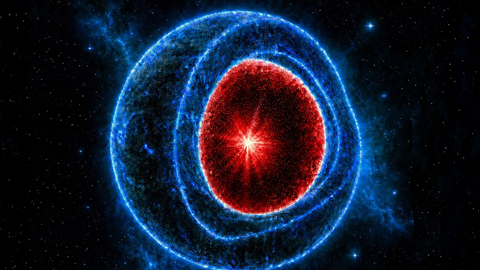
A new theoretical study offers an alternative scenario to gravitational collapse-instead of black holes, a collapsing star's core may produce a hypothetical gravastar. According to theorists, this process could trigger something unprecedented: the birth of an entirely new universe. The framework challenges decades of accepted understanding of black holes as the ultimate outcome of stellar collapse.
TechnologyA new theoretical cosmology study presents a bold hypothesis: the collapse of a dying massive star need not necessarily end in a black hole. Instead, in the complex conditions of the star's final moments, a hypothetical object may emerge, which scientists call a gravastar, and within it a new universe could burst forth.
Alternative to black holes
Black holes have been the most widely accepted endpoint of gravitational collapse for decades. Einstein's general relativity predicts that a sufficiently massive star will collapse into a singularity of infinite density when it dies. Yet physics has left several fundamental questions unanswered, such as what exactly happens inside the singularity and how to reconcile general relativity with quantum mechanics.
The recent study offers these questions an alternative framework. According to the gravastar concept, no true black hole forms; instead, quantum mechanical pressure halts the collapse just before the singularity forms, creating an extreme but finite-density object.
Birth of a new universe inside a star
The most surprising element of the theoretical model is the claim that the conditions accompanying gravastar formation could trigger the birth of a new universe. Such a scenario resembles the so-called "baby universe" hypotheses, according to which new universes could begin expanding from within a black hole or analogous object, remaining connected to our universe but becoming a separate existing spatial region.
If the hypothesis holds true, it would mean that our own universe could have similarly arisen from a star's collapse occurring in some other, older universe.
Theory's limitations
Scientists emphasize that this is purely theoretical work that cannot be directly tested with current instruments. Gravastars have not yet been directly observed, and distinguishing them from black holes would require measuring instruments that exceed the limits of today's technology.
Nevertheless, the study offers a fresh perspective for approaching one of physics' deepest unsolved problems: what truly happens under extreme gravitational conditions, where both general relativity and quantum mechanics must be taken into account simultaneously.
Open in app →