Does dark matter actually exist? Experts and an Estonian scientist are sceptical
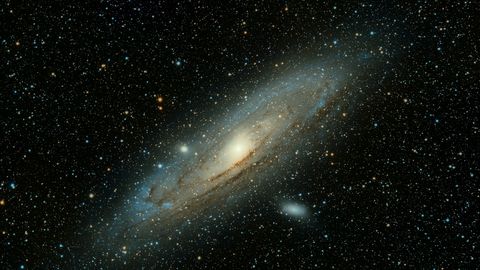
Astronomers have long believed that most of the universe's mass consists of invisible dark matter, whose existence has been inferred from its gravitational effects. However, no experiment has yet managed to directly detect dark matter, leading some scientists to question whether they are even looking for the right thing. Estonian cosmologist Hardi Veermäe is one voice explaining what we actually know and what we merely assume.
TechnologyAstronomy's greatest mystery, dark matter, has puzzled scientists for decades. Dark matter makes up an estimated 27 per cent of the universe's mass-energy balance, while ordinary visible matter accounts for only about 5 per cent. Yet no laboratory, detector, or space telescope has been able to conclusively capture dark matter.
Invisible, yet detectable
The existence of dark matter is inferred from indirect evidence: the rotation speeds of galaxies, gravitational lensing, and large-scale cosmic structures suggest that something invisible must be present. Without additional gravity, galaxies would simply fly apart. Yet no direct experiment, whether an underground neutrino detector or high-energy physics experiments in the largest particle collider, has found a dark matter particle.
Alternatives and doubts
This raises the question: what if dark matter doesn't actually exist? Some scientists propose alternative theories, such as modified gravity (MOND), which attempt to explain the observed anomalies without introducing a new form of matter. However, these theories cannot explain all observations as well as the classical dark matter model, particularly when describing large-scale cosmic structures.
Estonian cosmologist Hardi Veermäe explains in the Kukk Õuna podcast the current state of dark matter research, its strengths and weaknesses, and why this question remains scientifically unresolved. According to Veermäe, the dark matter concept is still the best existing explanation, but science cannot afford to settle for a theory that has not been experimentally confirmed.
What's next?
The scientific world is not standing still. Next-generation space observatories and underground detectors promise far more precise searches than before. The European Space Agency's Euclid mission, which will map the large-scale structures of the universe, should provide important clues as to whether the dark matter model holds up or whether physics must be fundamentally reconsidered.
The question "does dark matter exist?" is therefore not merely an academic debate—it touches on our understanding of the universe's most fundamental laws.
Open in app →