Putin critic Alexander Gogun: "Russian intelligence tried to recruit me in Moscow and Vienna"
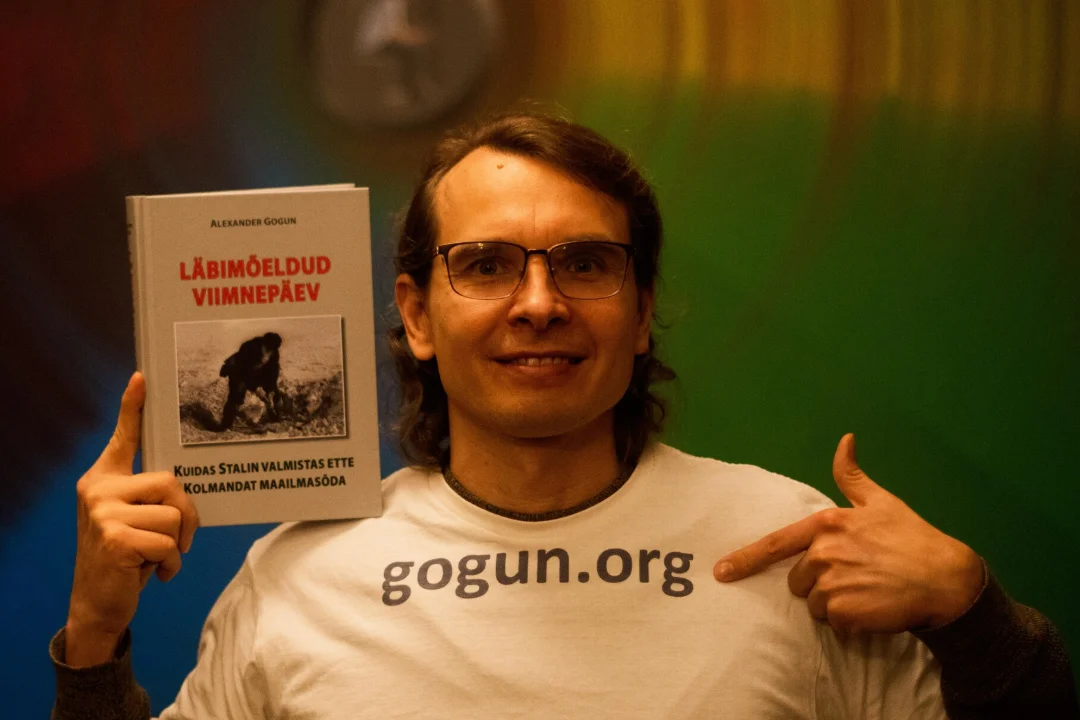
Russian-born historian and author Alexander Gogun, who has lived in Berlin since 2005, says the FSB attempted to recruit him twice and later targeted him with threats, mysterious parcels and email hacking. He has presented his book on Stalin at Estonia's Riigikogu and plans a new work covering Estonia's fate during World War II.
PoliticsRussian-born historian Alexander Gogun has lived in exile in Berlin since 2005, and his outspoken criticism of President Vladimir Putin has made him a repeated target of what he describes as FSB harassment, including two recruitment attempts, physical threats and covert cyber intrusions.
Two Recruitment Attempts
In an interview with Estonian outlet Õhtuleht, Gogun described how Russia's Federal Security Service (FSB) approached him on two separate occasions. «The FSB tried to recruit me twice, in Moscow in 2008, and in Vienna in 2016. I refused both times,» he said. He left Russia in 2005 not due to persecution, he explained, but to advance his academic career. However, after a 2012 article critical of Putin was published in a Ukrainian newspaper also widely read inside Russia, he concluded it was no longer safe for him to travel east of the EU's eastern border.
Threats, Parcels and Hacking
The intimidation intensified when Gogun was researching material for his latest book, Calculated Doomsday: How Stalin Prepared for World War Three, published in 2025. During that period, he was forced to contact German prosecutors and police, who detained a suspect, likely an FSB agent, at the German state archive. The individual was released after what authorities described as an «educational conversation».
Shortly afterwards, Gogun began receiving unsolicited packages in the post, including a metal bracelet that he interpreted as a reference to handcuffs. After he again reported the matter to police, the mysterious deliveries stopped. The harassment did not end there: FSB-linked actors subsequently hacked an email account belonging to a foundation through which Gogun communicated, and published stolen confidential correspondence online.
Estonian and Baltic Connections
Despite the pressures of exile, Gogun has remained productive and cultivated strong ties with the Baltic states. In December 2025, he presented the Estonian-language edition of Calculated Doomsday at Estonia's parliament building on Toompea Hill in Tallinn. In May 2026, he presented a Lithuanian translation of the same work at the Lithuanian parliament in Vilnius.
Gogun is candid about the difficulties of academic life in Germany. «German society is extraordinarily closed, and the German academic world is the most conservative in the European Union,» he said, adding that talent and qualifications count for little without the right connections, including, in his view, Kremlin lobbying. He noted that even two prominent German historians, Karsten Brüggemann and Olaf Mertelsmann, found it easier to build careers in Estonia, one now a professor in Tallinn, the other in Tartu, than in their homeland.
Plans for a New Book on Estonia
Gogun's next planned project carries the working title March of the World Revolution, 1939-1945, which would examine Stalinist international, domestic and military crimes during the Second World War. He says he specifically wants to address Estonia's fate in that volume. He is also seeking donors to fund the necessary archival research and volunteer translators to bring his earlier works, already available in Lithuanian and Latvian, into Estonian.
«I hope that publishing in Estonia will help move the book from a regional to an international level, at least reaching neighbouring Finland,» Gogun said. «It is important that Western readers can engage with this book right now.»
Open in app →