Tallinn's Soviet-era ceiling mural in cultural center to be covered with fabric
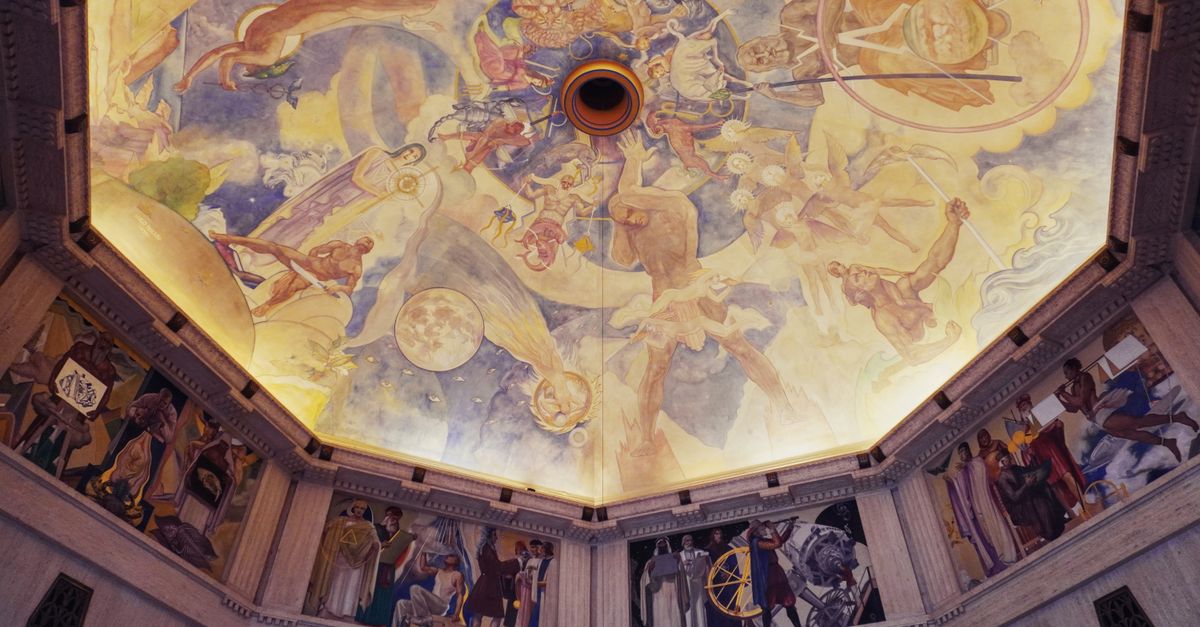
Tallinn City Culture Foundation will temporarily cover the Soviet-era ceiling mural depicting Red Army soldiers and naval imagery, along with star-decorated stucco decoration in the main hall of Mere Cultural Centre, to make the space more acceptable to visitors and potential tenants. The Heritage Conservation Agency approved the work in May 2026, and the solution is fully reversible. Renovation work will take place from 1-14 July 2026.
CultureTallinn's Mere Cultural Centre main hall will become significantly more neutral in July: the city institution Tallinn City Culture Foundation will cover the Soviet-era ceiling mural depicting Red Army soldiers and naval fleet, along with star-decorated stucco decoration, to make the space more acceptable to visitors and tenants.
Why is the mural being covered?
According to Kaisa-Liis Kalda, a representative of Tallinn City Culture Foundation, heritage conservation permission for the work was obtained in May 2026. "It is important to us that Mere Cultural Centre is an open and welcoming place for everyone, for Estonian people, minority populations living in Estonia, including people of Russian ethnicity, as well as international visitors. For this reason, we want the environment in this building to be as neutral, contemporary, and inclusive as possible," Kalda explained.
Kaarel Truu, a representative of Tallinn City Planning Department's heritage conservation division, described the problem vividly: "This mural and the entire interior are very strongly ideologically charged. For some people it is even unpleasant, and the people at Mere Centre said they cannot use this space because tenants and the public are unwilling to come there."
According to Truu, the ceiling mural depicts Soviet imperialism in an interesting perspective: "This ceiling mural is Soviet imperial propaganda. The people depicted in the mural are all in Soviet military uniforms. And there is also Soviet naval symbolism, stars and anchors." Information about the author of the mural is not available.
A reversible solution
A solution has been found in cooperation with heritage conservation that does not damage the original artwork. The ceiling will be covered with fabric stretched on a frame, which will hide the mural, but the lighting fixtures will remain in their current location. The star-decorated stucco decoration surrounding the stage opening and on the balcony railings will be concealed with neutral gypsum elements. Kalda emphasized that everything being concealed will be preserved in its original form: "These will be preserved under stickers and new ornamental elements. The architectural element will be installed whole on a wheeled frame and stored. The building's historical value will be preserved even after these changes are made."
Anita Staub, head of the Heritage Conservation Agency's built heritage division, confirmed that the entire building, including the ceiling mural, remains under heritage protection. She specified that Tallinn's heritage conservation division of the City Planning Department handles built heritage sites in Tallinn under an administration agreement, and the Heritage Conservation Agency is always represented in the decision-making commission.
The building's Stalinist legacy remains
According to Truu, the building's historical significance does not disappear by concealing the most conspicuous symbols: "The story of the Cold War and Soviet occupation can be told very successfully even after the symbols are covered, because there are so many stars in the foyers and stucco decoration everywhere that the entire building is permeated with them." Beneath the Soviet-era layers in the hall, the structures of an earlier, pre-Soviet large cinema have also been preserved.
A similar fate will not befall the Estonian National Opera, whose star-decorated ceiling mural has also attracted attention in recent years, according to Truu. "The role of the Estonia hall and mural in Estonian cultural history is much more important, much more discussed and written about. There has been no talk of anyone wanting to cover it," Truu said.
Tallinn City Culture Foundation has managed Mere Cultural Centre since 2025. The building was previously known as the Russian Cultural Centre and Officers' House. In April 2025, a Soviet architectural element was removed from the cultural centre's façade. Renovation work on the main hall of Mere Cultural Centre will take place from 1-14 July 2026.
Open in app →