Third dark matter-deficient galaxy discovered 67 million light-years away
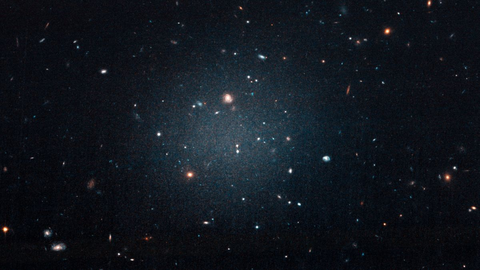
Astronomers have discovered a third galaxy with an extreme lack of dark matter. DF9 is located 67 million light-years away and belongs to a mysterious galaxy cluster that challenges existing cosmological theories. Scientists suggest the explanation may lie in an extraordinary violent galaxy collision scenario.
TechnologyAstronomers have made another surprising discovery: galaxy DF9, located 67 million light-years from us, contains almost no dark matter at all. This is already the third such object in one and the same mysterious galaxy cluster, and each new finding deepens the mystery.
Dark matter, the universe's invisible scaffold
Dark matter makes up the majority of the mass of most galaxies and is the foundation of all cosmic structure. Its gravity holds galaxies together and directs their evolution. For this reason, it seems theoretically almost impossible that a galaxy could exist without a significant amount of dark matter-it would be like a house from which the invisible framework has been removed, yet which still stands upright.
Yet DF9 appears to be doing exactly that. Astronomers cannot explain with conventional models how this galaxy stays together at all and what it is actually made of.
Violent collision as a key scenario
One of the leading explanations that scientists have arrived at points to extraordinarily violent galaxy collisions in the past. During such a collision, dark matter could have separated from the galaxy's ordinary matter and been carried away in another direction, leaving behind a body consisting only of stars and gas with almost no dark matter.
This scenario does not disprove the existence of dark matter in the universe, but rather confirms it: dark matter would simply have been transported elsewhere during the physical process. The galaxy cluster in question may be the remnant of an earlier massive cosmic catastrophe.
What does the third discovery mean?
The discovery of the first dark matter-deficient galaxy could have seemed like an anomaly. The second raised questions. The third, DF9, turns this phenomenon into a systematic problem that requires a coherent theoretical explanation.
Scientists hope that further observations, particularly using next-generation telescopes, will help map the more precise history of the galaxy cluster and clarify whether this is indeed the aftermath of one great catastrophic event or something else that current cosmological models cannot predict.
Open in app →