What will happen to Estonia's climate if the Gulf Stream stops?
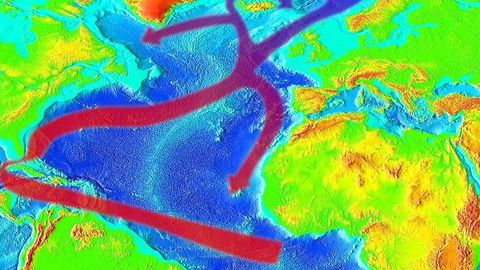
On Kuku radio's science programme "Clear Picture," science communicator Marek Strandberg, Indrek Ojamets and Indrek Vaheoja discussed the potential consequences of the Gulf Stream weakening. If Greenland's melting brings too much fresh water to the end of the current, it could disrupt the global ocean conveyor. For Estonia, this would mean climate change towards something more like Siberia: colder winters, permafrost, and changes to food production.
TechnologyOn Kuku radio's science programme "Clear Picture," science communicator Marek Strandberg, Indrek Ojamets and Indrek Vaheoja discussed what would happen to Estonia's climate if the Gulf Stream were to weaken significantly or stop entirely.
How does the Gulf Stream work?
Strandberg explained that the Gulf Stream carries warm water across the Atlantic Ocean towards Greenland. There the warm surface water cools, becomes saltier and heavier, and sinks into deeper layers, from which it returns as a deep-water current in the opposite direction. This process forms a kind of global conveyor belt that affects climate far beyond the Atlantic itself.
It is precisely because of this circulation of warm water and air masses that Estonia's climate is considerably milder than its geographical location would otherwise suggest. Some extremely cold regions in Siberia are located even further south than us, yet their climate is drastically harsher.
Greenland's melting as a threat
According to one hypothesis, extensive melting of Greenland could trigger a weakening of the Gulf Stream. If meltwater brings large amounts of fresh water to the end of the current, it becomes less saline and lighter, and no longer sinks to the bottom, which is essential for the conveyor to function. Thus the entire system could be disrupted or even stop.
Strandberg emphasized that the climate system is full of natural fluctuations, with both the atmosphere and oceans oscillating. This is a very complex problem that cannot be solved simply "on your fingers," but scientists have studied this issue thoroughly.
What would this mean for Estonia?
If the Gulf Stream were to stop or weaken noticeably, Estonia's climate would become somewhat more like Siberia's. Winters would likely be considerably colder, in some regions permafrost could develop, and current agricultural methods might no longer be viable.
Water regimes on continents would also change, and as the climate warms, the northern hemisphere receives ever more fresh water through rivers to the ocean, which in turn deepens the threat to the conveyor's functioning. When asked whether something old would disappear and something new and interesting would take its place, the answer was rather cautious: the changes would be predominantly difficult for human society, not exciting.
Open in app →